In the ever-expanding universe of Halo Infinite’s Forge mode, a new prototype is turning heads and sparking waves of nostalgia. A dedicated community creator going by the name DanTheBloke recently shared a project that revives one of the most unexpected and joyously chaotic custom game types from early first-person shooter history. The idea is simple yet brilliant: two teams, separated by a massive block of destructible material, must dig tunnels toward each other and eliminate the opposition. The mode is still in its infancy, but it already channels the spirit of an obscure Counter-Strike variant that captured the imaginations of players over two decades ago.
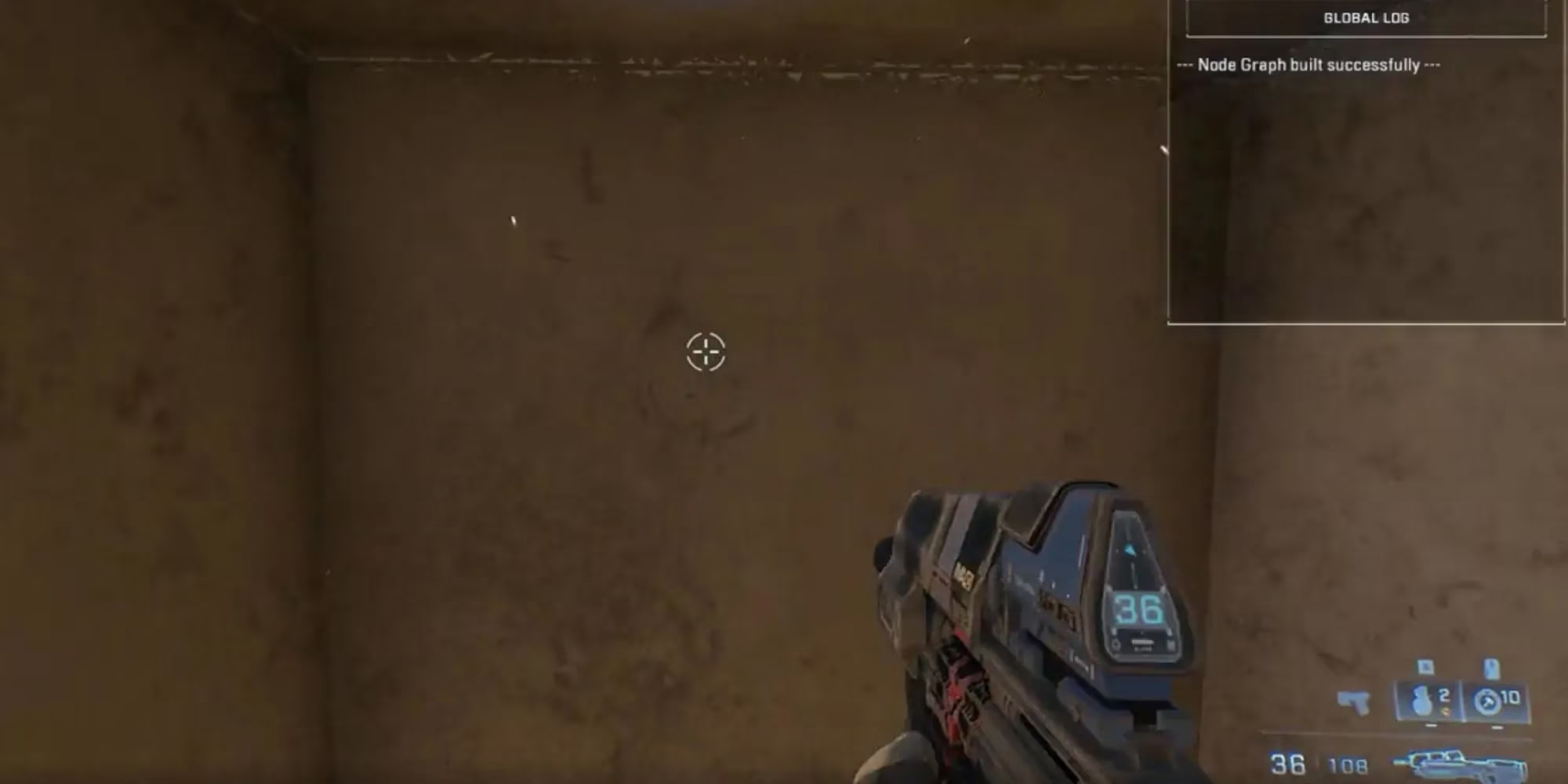
Long before battle royales and hero shooters rewrote the rulebook, Counter-Strike servers experimented with maps and mods that felt more like digital playgrounds. One such creation dropped players into a solid volume of breakable cubes and handed them nothing but a pistol. The objective was to carve out passages, stumble upon rivals, and survive. It was a free-for-all experience where strategy meant choosing the right angle to chip away at the geometry while listening for the telltale sounds of someone else doing the same. DanTheBloke’s Halo Infinite prototype refines that raw concept, injecting it with teamwork and a distinct explosive twist.
The core loop has participants adopting specialized roles. Unlike the Counter-Strike original, where every player could shoot blocks apart, this Forge creation assigns the digging duty to designated ‘miners’. Currently, two miners operate on each side, making four in total. This limitation is not just a stylistic choice—it prevents the map from being torn to shreds within the first minute. In the old Counter-Strike mode, matches often ended inside a vast, hollowed-out cavern with only scattered remnants of cubes still standing. The Halo take promises a more deliberate pace, forcing teams to coordinate. Miners must discuss which direction to expand, when to detonate charges, and how to create flanking routes without exposing their own base. Communication becomes a weapon.
The method of destruction itself marks a significant departure. Instead of endlessly firing bullets at walls, players plant explosive charges and trigger them remotely. The change adds a layer of tension. A miner might set a charge and wait, wondering if the blast will reveal an empty cavity or the wide-eyed stare of an enemy caught mid-swing. The entire dynamic shifts the focus from twitch reflexes to timing and map awareness. Sudden breakthroughs lead to frantic close-quarters skirmishes where no cover exists. There is no pre-built geometry to hide behind, only the raw, unpredictable contours of a handmade battlefield.
That unpredictability is what made the original mode so magnetic, and DanTheBloke’s version seems ready to bottle it. Every match generates a unique three-dimensional labyrinth. One round might see the teams drilling parallel lines that never intersect until the final seconds; another could collapse into a chaotic crossfire within the first thirty seconds. The absence of traditional cover means that when two tunnels finally connect, the resulting gunfight is brutally honest. Aim, movement, and sheer luck decide who walks away.
The Halo Infinite community has already started drawing connections to other games. Some users on the Halo subreddit compared the prototype to Ace of Spades, the blocky battle builder that DanTheBloke himself cited as inspiration. Others mentioned Brickforce, Minecraft’s various mining deathmatch mods, and even the satire-laden Deep Rock Galactic salute of “Rock and Stone.” But the ancestral DNA is unmistakably tied to that old Counter-Strike custom scene. It feels fitting that Halo’s Forge, which has already welcomed fan-made recreations of surfing maps, would embrace another slice of classic PC gaming culture.
As of 2026, the prototype remains a work in progress. The creator has stated that they aim to smooth out performance hiccups that might arise when multiple players trigger explosions simultaneously. There are also discussions about introducing a broader range of equipment options for miners, perhaps allowing for different charge types—delayed fuses, directional blasts, or even decoy explosions to mislead the opposition. These additions would deepen the tactical layer and bring the mode closer to a full-fledged competitive experience.
Looking back, Counter-Strike’s tunneling mode never achieved mainstream status. It existed in the shadowy corners of server browsers, passed along by word of mouth. Yet those who played it remember the adrenaline rush of breaking into an enemy’s burrow, the frantic pistol duels, and the laughter that erupted when two miners dug directly into each other’s faces. DanTheBloke’s prototype has the potential to introduce a whole new generation to that very feeling, wrapped in Halo’s sandbox of weapons and movement.
The timing could not be better. Halo Infinite’s population has stabilized around a core of creative players who constantly push Forge’s limits. Modes like this thrive on community servers where experimentation is encouraged. If the final version captures even half the absurd fun of its predecessor, it will almost certainly spread across custom game browsers. After all, the joy of tunnel combat lies in its simplicity: a wall between you and your enemy, a tool to break it, and the delicious terror of not knowing what lies on the other side. The circle of FPS creativity keeps turning, and right now it’s digging straight through a block in the middle of a Halo map.